



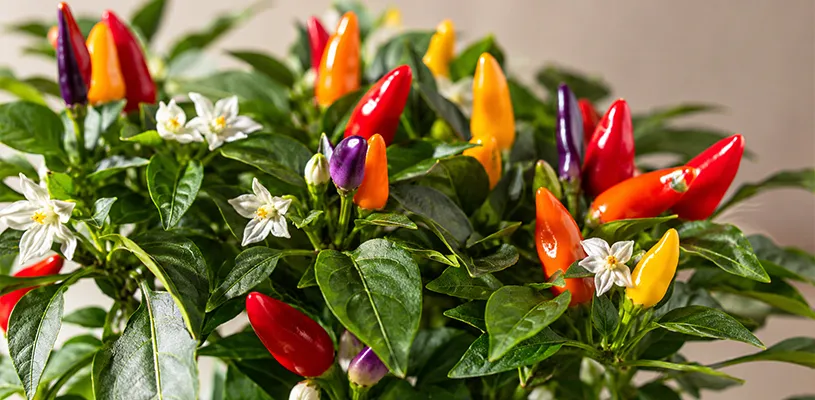
There is something special about picking your own chili straight from the kitchen counter in the middle of winter. And even though chili can feel like a plant for greenhouses and summer warmth, it actually grows very well indoors all year round - if you choose the right varieties and give the plants the right conditions.
The nice thing is that chili is also much more fun to grow than many people think. Some varieties are colorful, almost like small ornamental plants, while still producing genuinely useful fruit.
Start with the right chili variety
The biggest mistake many people make is choosing the wrong variety right away. Large habanero or jalapeño plants can absolutely work indoors, but they often need more light, more space, and much more patience.
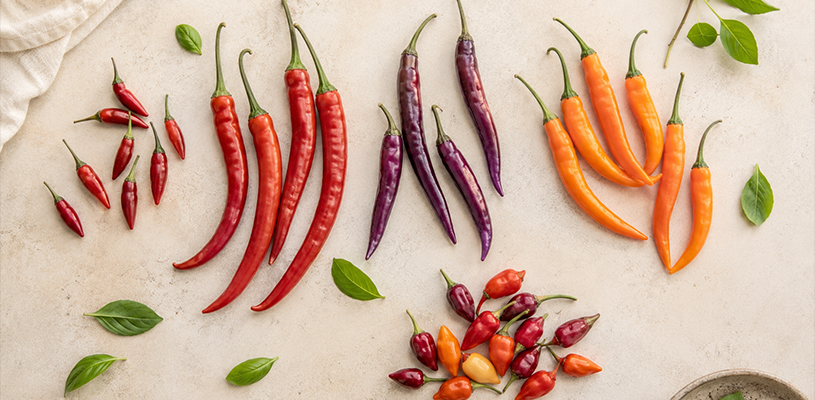
For indoor growing, compact varieties work much better.
Here are some of the best chili varieties for indoor growing:
|
Variety |
Heat (SHU) |
Plant size |
Harvest time |
Best for |
|
Apache |
70 000-80 000 |
Compact |
70-90 days |
Beginners |
|
Basket of Fire |
30 000-50 000 |
Trailing |
80-100 days |
Windowsills |
|
NuMex Twilight |
30 000-50 000 |
Compact |
75-90 days |
Decoration + food |
|
Purple Chili Pepper |
10 000-30 000 |
Small |
70-90 days |
Smart Garden |
|
Thai Chili |
50 000-100 000 |
Medium |
90-120 days |
Spicy food |
|
Cayenne |
30 000-50 000 |
Medium |
80-100 days |
Drying |
Apache chili is often a perfect starting point for beginners. It stays fairly compact but still produces plenty of fruit.
Light is absolutely crucial
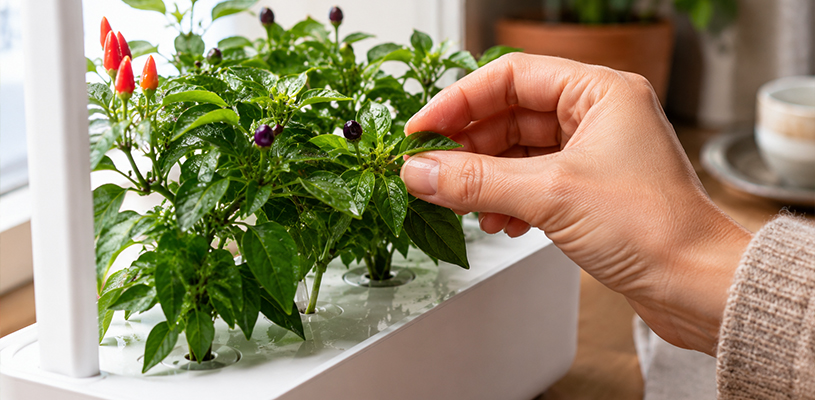
Chili loves light. It is almost impossible to overstate how important it is. In summer, a very bright south-facing window can work well, but in autumn and winter, daylight rarely is enough in Sweden. Then the plants become tall, thin, and produce very little fruit. To grow chili all year round, you therefore almost always need some kind of grow light or smart garden solution.
Many modern indoor gardens handle this automatically with LED lighting adapted for plants. It makes a big difference, especially for people who want to grow chili in an apartment without perfect light conditions.
How much water chili needs
Chili likes even moisture but does not want to sit wet all the time. That balance is quite important. Too much water is actually more common than too little. When the soil never gets a chance to dry out a little, the roots can suffer and the plant quickly starts to look droopy.
A good trick is to feel the soil before watering again. If it still feels noticeably moist, you can usually wait a bit longer. Smaller plants also drink much less than large plants with lots of fruit.
Pollinating chili indoors - why there are sometimes no fruits
One of the most common frustrations with indoor chili growing is that the plant blooms nicely but never develops fruit. Outdoors, wind and insects help with pollination, but indoors you sometimes need to help the plant a little yourself.
It is often enough to gently shake the plant once a day when it is blooming. A small brush also works well if you want to be extra careful. Some smart garden systems also help by providing stable air circulation and a steady environment, which usually gives better results.
Smart garden chili - easier than many people think
A few years ago, smart gardens mostly felt like a tech gadget, but today they are actually a very convenient way to grow chili at home. The big advantage is that much of the guesswork disappears. The light is controlled automatically, and the pods already contain the right balance of nutrients and soil-like material.
That does not mean everything happens magically, but the barrier is much lower for beginners who want to get started quickly. Purple Chili Pepper pods and different Chili Pepper Mix packs also work surprisingly well in smaller kitchens where there is no room for large pots and grow lights everywhere.
How long does it take to grow chili?
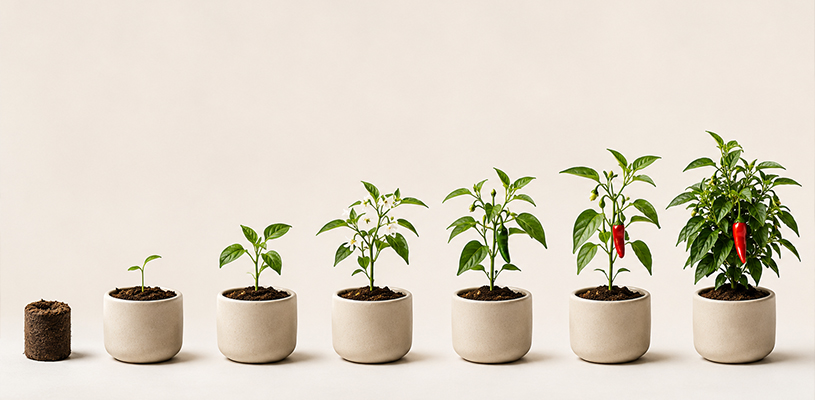
Chili takes a bit of patience. It is not like chives, where something happens right away.
Most varieties need roughly:
- 1-3 weeks for germination
- 1-2 months before flowering
- 2-4 months to the first ripe fruit
That sounds like a long time, but once the plant gets going, it can keep producing chili for quite a while under the right conditions.
Can you overwinter chili indoors?
Yes, actually. Chili is really a perennial plant, even though many people treat it as an annual. Overwintering chili indoors works best if the plant gets plenty of light and grows a little more slowly during the winter. Many people prune the plant lightly and reduce watering somewhat. The advantage is that older plants often get going faster and produce a larger harvest the next season.
Summary
Growing chili indoors is a little addictive once you get started. First you try one plant, then suddenly you find yourself comparing SHU levels and wondering whether you really need one more variety.
But for beginners, the smartest approach is to keep it simple. Choose a compact variety, give the plant plenty of light, and do not stress about perfect conditions right away.
The most important thing is really just to get started.
FAQ
Which chili is easiest to grow indoors?
Apache and Purple Chili Pepper are two very good varieties for beginners.
Does chili need grow lights?
Yes, usually during autumn and winter in Sweden if you want good growth and fruiting.
How often should chili be watered?
When the soil starts to feel slightly dry a few centimeters down.
How long does it take to get chili?
Usually between 2 and 4 months, depending on the variety and light conditions.
Can chili survive for several years?
Yes, chili is actually perennial and can be overwintered indoors.